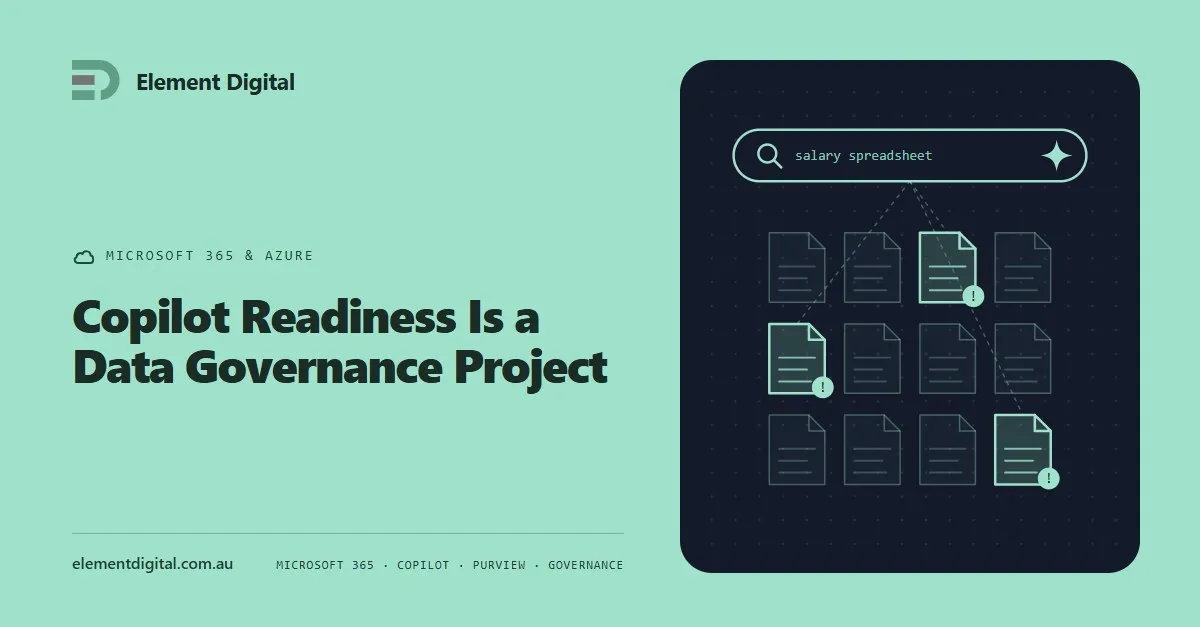
Copilot Readiness Is a Data Governance Project
Copilot does not create an oversharing problem. It makes the one you already have searchable. What to fix before you buy the licences.
An Azure budget does not cap anything, it sends an email. Here is how to set budgets and alerts so they buy you time, and what actually reduces the bill.

An Azure budget does not cap anything. It sends an email.
That is the most important thing to know before you set one up, because the name implies a limit and it is not one. Used well, budgets and alerts still do the job. They buy you time, which is the thing you actually need when costs start moving.
You set an amount against a scope and a period. A subscription, a resource group, or a set of resources filtered by tag. Then you set thresholds, and Azure notifies you as spending crosses each one.
Nothing stops. Nothing switches off. You get told.
That sounds weak, and it is not. Almost every bad cloud bill we have seen was something running for weeks before anybody looked at it. An alert on day two turns a five-figure problem into a three-figure one.
Budgets sit under cost management in the Azure portal. The exact path moves, so search for cost management rather than trying to remember a menu route.
A few choices separate a budget that helps from one that becomes noise.
Alert on forecast as well as actual. Azure projects where your spending is heading from the current run rate, so a forecast alert tells you in week one that you are going to overshoot, instead of telling you in week four that you did.
Use several thresholds. 50 percent, 75 percent and 90 percent is a sensible set, each carrying a different level of urgency.
Send them to a group rather than a person. Alerts addressed to one individual go unread the moment that individual takes leave, which is reliably when you need them most.
Set one at subscription level and more at resource group level. The subscription budget catches the total. The resource group budgets tell you where it came from.
Budgets can filter by tag, and that is where the real value sits. It is also the part that usually never gets done.
If resources are not tagged by project, team or client, you can see the bill went up but not which piece of work caused it. Every cost investigation then becomes an afternoon of guesswork.
Enforce tags with Azure Policy so untagged resources cannot be created at all. Do it before you need the data, because retrofitting tags across a live environment is grim work.
Azure flags unusual spending patterns on its own, with no threshold for you to configure.
Turn it on. It catches what a budget misses, such as a resource that never gets expensive enough to breach a threshold but has quietly started costing three times what it used to.
You have to build that part yourself.
A budget alert can trigger an action group. An action group can call a runbook. The runbook can deallocate virtual machines, or remove a subscription’s ability to deploy anything new.
That is the right answer for development and test subscriptions, where a hard stop is merely annoying. Be far more careful in production, because an automated shutdown at the wrong moment is just an outage you caused yourself.
Alerts tell you about spending. They do not reduce it. Three things usually do.
Reservations and savings plans, for anything that runs continuously. The discount is significant and the commitment is the only real cost.
Right-sizing. Azure Advisor will tell you which virtual machines are oversized, and in our experience it is usually right.
Turning things off. Development and test environments do not need to run overnight or at weekends. A shutdown schedule takes about an hour to build and cuts those subscriptions by more than half.
Budgets watch money. Quotas cap capacity. You want both, and we covered the other half in Setting Up Azure Quotas to Prevent Bill Shock.
The division of labour is simple. Quotas stop the accident, budgets tell you about the drift, and a person still has to act on what they are told.
Element Digital offers IT consulting services in Hobart. If you want a hand getting an Azure bill under control, get in touch.
Copilot does not create an oversharing problem. It makes the one you already have searchable. What to fix before you buy the licences.
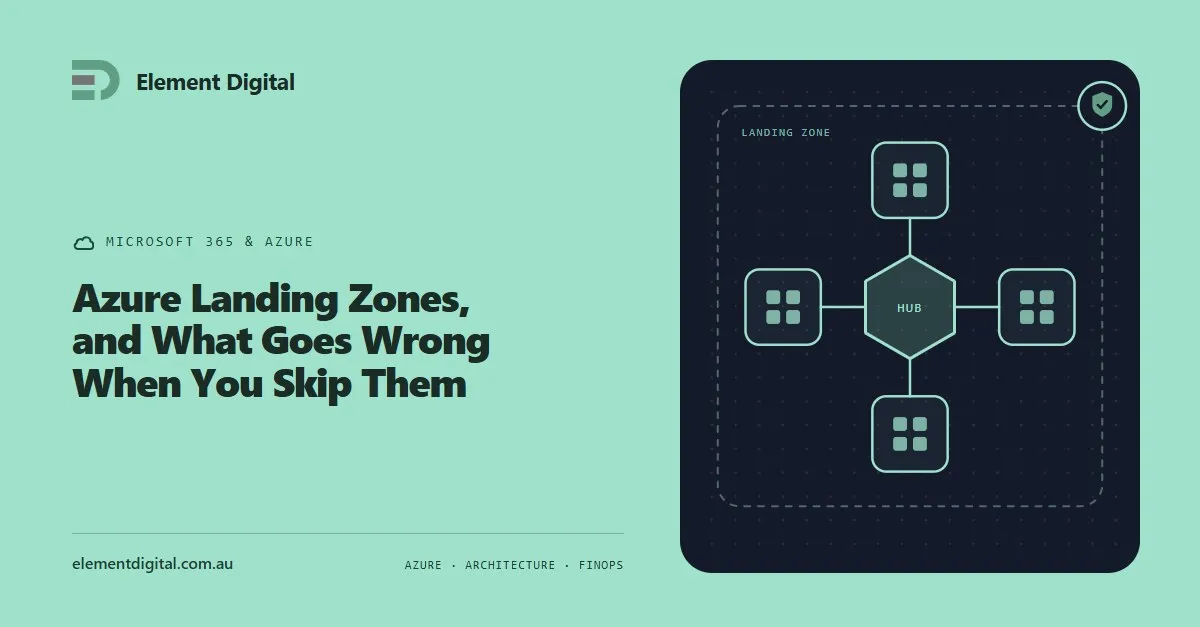
Most Azure estates were not designed, they accumulated. What a landing zone actually is, what an unplanned estate costs you, and how to fix one in place.
Microsoft keeps your service running. It does not keep a copy of your data for you. Where the retention ends, and how people find out the hard way.
Let us talk about what you are trying to achieve, no obligation, just a conversation.